Teladoc.
Not ranked for telemedicine in 2015. Number one for telemedicine today. The architecture I helped build is the surface they are still scaling on top of.
Every C-suite buyer who lands on this site is asking the same question. Not out loud — they’re too polite for that — but it’s the question that decides whether you take the next meeting:
“Has this person actually built something at scale that survives a decade and three CMO transitions?”
Fair question. Let me answer it with one client.
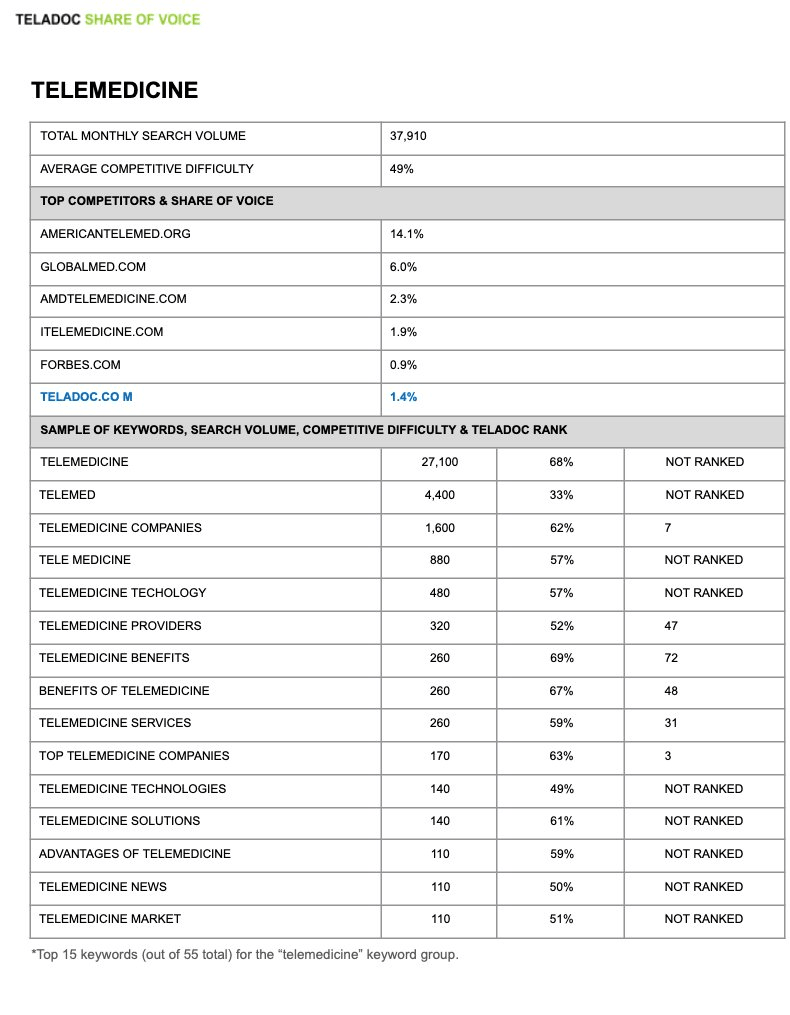
In September 2015 — two months after their IPO — Teladoc held 1.4% share of voice in the telemedicine search category. They were not ranking for telemedicine. Not ranking for telemed. Not ranking for telecare. Or thirty-plus other category-defining keywords. The newly-public company defining virtual healthcare was invisible in the searches that defined virtual healthcare.
I led the engagement as CEO of the agency. Principal Strategist on the contract.
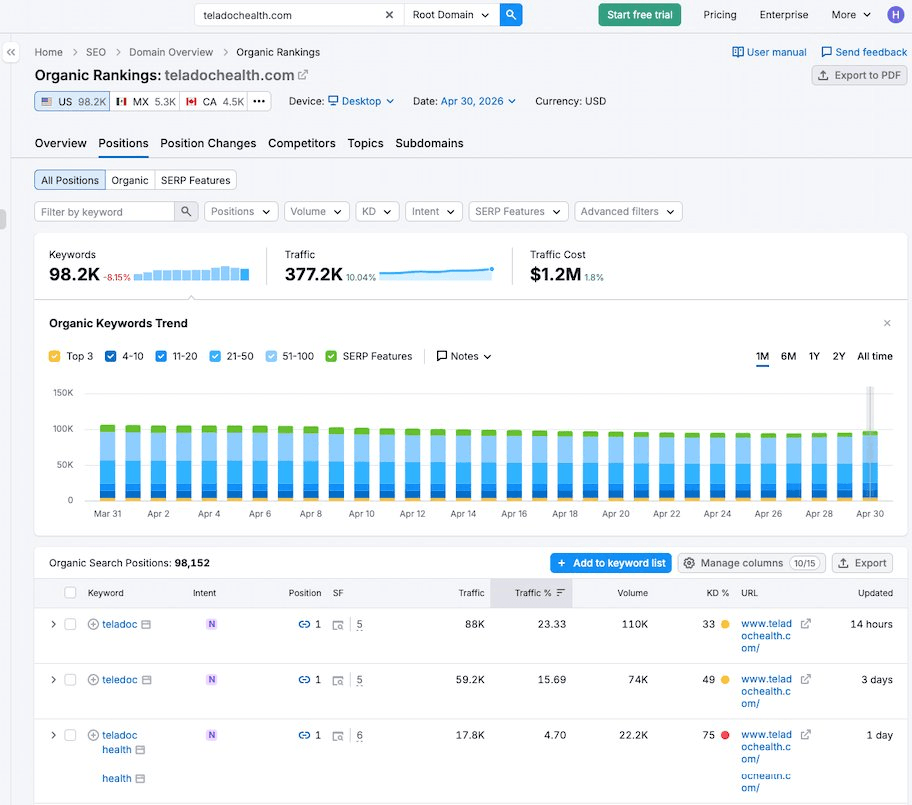
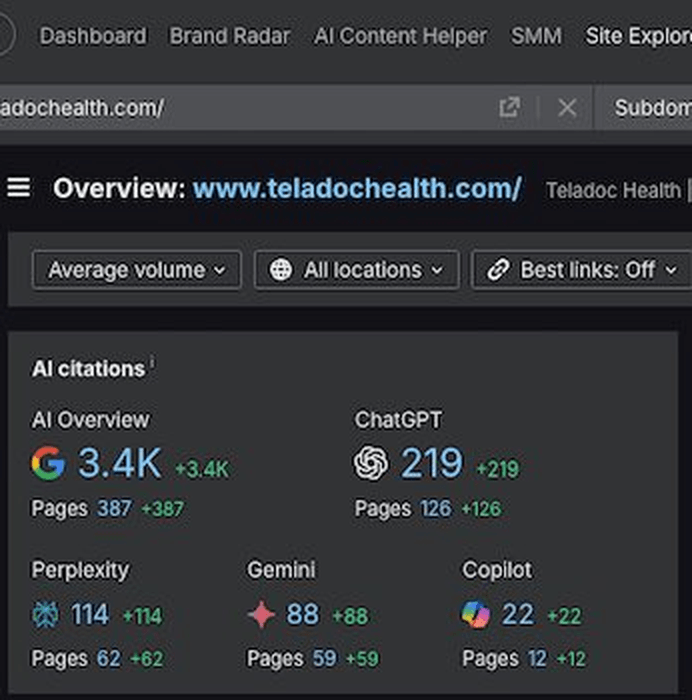
Type those same keywords into Google today. Teladoc Health is #1 for telemedicine. #1 for telemedicine services. #1 for online counseling. #1 for virtual doctor visit. #1 for online doctors. Their domain produces approximately $1.21 million per month in organic traffic value across roughly 98,000 keywords, with 3,400+ citations in Google’s AI Overviews and additional presence across ChatGPT, Perplexity, Gemini, and Microsoft Copilot.
The foundation we built in 2015 is the surface they are still scaling on top of in 2026.
This page is the receipts.
A 1.4% share of voice in their own category.
Two months earlier, Teladoc had filed a successful IPO. The company had nearly 11 million members. Roughly 600,000 telehealth visits projected for 2015 — double the 300,000 they had completed the year before. A new public market valuation. And a category they had pioneered — virtual healthcare — that the entire industry was about to scramble to claim.
On September 3, 2015, the share-of-voice baseline looked like this. In the telemedicine keyword category — the one that defined what their product was — Teladoc held 1.4% share of voice. The competitors above them included a trade association, several smaller telemedicine-software vendors, and a Forbes article. Teladoc, the public-market category leader, ranked behind a magazine article.
For the priority terms — the ones the brand had to own to win the category — the dashboard read NOT RANKED: telemedicine, telemed, tele medicine, telemedicine technology, telemedicine technologies, telemedicine solutions, advantages of telemedicine, telemedicine news, telemedicine market. Not page two. Not position 100. Not in the index at all.
That was the starting point. Not the version a marketing department reframes for a board deck. The version captured in dated competitive-intelligence documents. The version a public-market healthcare company had to confront before any of the rest of the work could begin.
I owned the architecture phase.
The agency on the Teladoc account was the firm I ran as CEO — a brand that today operates as a sub-brand inside Digital Strategy Group. The agency won the engagement against multiple bidders through a formal RFP process. The proposal we walked into Teladoc’s Lewisville, Texas headquarters with on September 3, 2015 was titled “Building Self-Sustaining Fishing Ponds of Organic Traffic.” Pre-IPO metaphor aside, the thesis was simple: stop renting traffic. Build it.
Out of more than four agency bidders, we advanced to the final round of two — and were selected to win.
We were among the lowest bids in the RFP. Teladoc’s brief signaled budget appetite materially higher than what we ultimately contracted at. They chose architecture over price. The work expected was commensurate.
My role on the contract was Principal Strategist — the senior strategic lead, owning the architectural recommendations, the share-of-voice methodology, and the deliverables that defined what got built. I decided what got built and validated what got shipped.
That distinction matters because architecture is what compounds. Execution iterates and gets replaced. Foundations do not.
What the agency was hired to build.
-
01Analytics infrastructure.Google Analytics. Google Tag Manager. Google Webmaster Tools. Bing Webmaster Tools. Heat-map installation. The measurement layer Teladoc would scale on for the next decade.
-
02Toxic backlink audit.Full audit across Google Webmaster Tools, Majestic, and Open Site Explorer — including every domain redirecting into teladoc.com from prior acquisitions. Disavow file creation and outreach for link removal where warranted.
-
03Keyword research and mapping.Search volume and competitive difficulty modeled across every vertical Teladoc served. Approved keyword set mapped to landing pages and signed off by Teladoc’s brand team.
-
04Meta architecture.Individual title and meta description tags for every rankable page. Brand-guideline-aligned messaging. Canonical and pagination protocols.
-
05Site migration consultation.A 310-URL migration map covering teladoc.com and every pre-migration domain feeding into it. 301 redirect strategy and post-migration ranking-recovery protocol.
-
06Content audit.Editorial library scored against the keyword taxonomy. Recommendations for restructuring, consolidation, and new asset development. The substrate the Knowledge Center architecture would sit on.
Six months. The receipts.
The engagement ran from September 3, 2015 to March 1, 2016. About six months. Within that window, the team executed against every contracted Phase 1 deliverable, identified one strategic move that was not in the original scope, and moved Teladoc’s organic search into the company’s number-one acquisition channel by the final month before termination.
The contracted scope was SEO architecture. The work itself was multi-layered marketing infrastructure — analytics, brand voice, content production governance, B2B segmentation, member portal strategy. CMO-track work delivered under an SEO contract title.
The strategic move that wasn’t in the contract.
Mid-engagement we identified that Teladoc had a substantial corpus of internally-produced clinical and member-education content sitting outside their public search footprint — case studies, condition explainers, expert-reviewed articles, member-experience material. Thousands of pieces. Most of it was member-portal-gated and living inside internal systems where Google could not see it.
The strategic recommendation: architect a public Knowledge Center that would unlock the corpus into search-visible inventory under the keyword taxonomy we had built in Phase 1, restructured against the seven B2B audience verticals, with the most authoritative content surfaced first.
We did a partial launch. Recommending and creating new pages. Restructuring existing content. Removing duplicates. Rearranging others. Using selected pieces for offsite SEO strategies. The full unlock was in motion when the engagement ended.
Eleven years later, teladochealth.com publicly operates a Health Library, a Help Center subdomain, B2B Resource Centers, vertical-specific insight hubs for Hospitals and Health Systems, and a consumer Health Talk blog — all clinically reviewed and expert-authored — across the exact information architecture we proposed. The descendant of the unlock is live, public, and indexed.
The dashboard at termination.
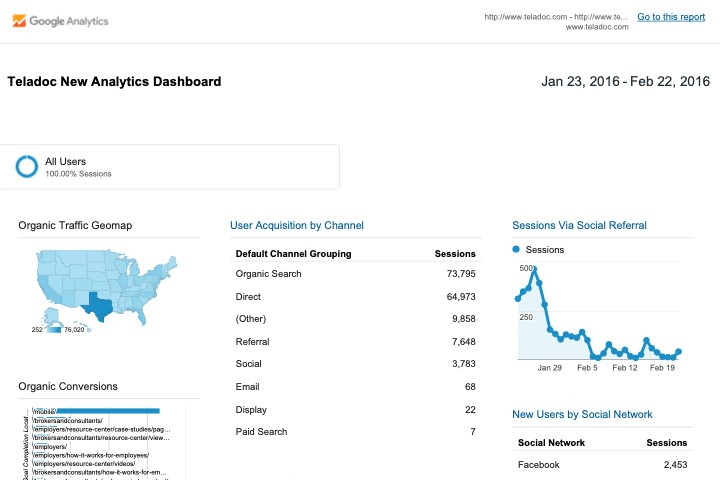
By February 2016 — month five of the engagement — Teladoc’s analytics dashboard recorded the following thirty-day window:
| Metric (Jan 23 – Feb 22, 2016) | Value |
|---|---|
| Total monthly sessions | ~160,000 |
| Organic search sessions | ~73,800 |
| Organic share of all traffic | 46% |
| Top acquisition channel | Organic Search |
Six months earlier, Teladoc held 1.4% share of voice in their own category and ranked nowhere for the words that defined it. Five months into Phase 1, organic search was their single largest acquisition channel — pulling more sessions than direct, referral, social, paid, email, and display combined. The foundation was already producing.
That was the state of the build on March 1, 2016. The engagement ended that day.
The contract ended in March 2016.
On March 1, 2016, the contract was terminated.
The contract had a 30-day wind-down. We took it.
Here’s the part that matters. Termination wasn’t about performance. At the moment of the call, Teladoc owned 46% organic share of all site traffic — up from a starting point where most of their priority terms didn’t rank at all six months earlier. The foundation was working. Everyone in the room knew it.
Termination was structural. Teladoc had decided to bring SEO in-house. They hired the incoming Director of SEO — full-time, on-staff, reporting into marketing leadership. That’s the decision a company makes when it realizes the channel is too important to keep outside the building. It’s the kind of decision that happens when an external team has done the work well enough that the discipline becomes core infrastructure worth owning.
That’s the part of the agency business nobody puts on a case study slide. When you build something that compounds, the people writing the checks eventually decide they want to own it themselves.
We didn’t slow down during the wind-down. We didn’t hold the work hostage. We didn’t run out the clock on the final thirty days.
I personally onboarded the incoming Director of SEO during the handoff. Added him to the working sessions in the second week of March, walked him through the architecture, the keyword segmentation, the share-of-voice methodology, the prioritization logic, the queue of recommendations still in flight. By the time the contract formally closed on April 4, 2016, the in-house team had everything it needed to operate the channel without us.
That is how a senior team closes out an engagement. Not with a stalling email and a final invoice. With a transfer of operational knowledge.
Then three years went by.
The infrastructure we recommended, architected, and partial-launched — the resource hubs, the library framework, the keyword segmentation, the share-of-voice operating model — kept working. The in-house lead was in the seat. The foundation didn’t need us to keep producing returns. That’s what foundation means.
I watched it from outside, the way operators watch work they used to own.
On March 21, 2019 — three years and twenty days after the contract closed — the same Director who’d taken the seat in 2016 emailed me.
By that point his title had moved from Director of SEO to Director of Digital Marketing at Teladoc Health. Same person. Same building. He wrote to ask if I’d be open to picking up the conversations we’d started in 2016.
That email is the proof point.
A former director-level client at a public healthcare company does not email an outside operator three years after termination unless the work that operator did is still operating in his head as the standard. He didn’t reach back to the dozens of agencies that had pitched him in the interim. He reached back to the team that had owned the architecture phase.
The 2019 scoping rounds didn’t close.
That part I’ll say plainly. We worked the conversations through several rounds and didn’t get to terms that matched the scope I believed the engagement actually required at that stage of Teladoc’s growth. So the deal didn’t happen.
That’s not a failure. That’s discipline. Nine times out of ten in this business, the senior operator’s job is to know when not to take the work — when the gap between what the client wants to spend and what the engagement actually requires would force the team to under-deliver. Walking away from a marquee logo because the math doesn’t work is harder than signing it. I’ve done the harder thing more than once. That standard is the same one I apply to every Fractional CMO engagement today.
So this is the honest version of the case study most agencies wouldn’t write.
I built and led the architecture phase that took Teladoc from “not ranked” on its priority terms to category leadership. I got terminated. I handed off the work the way it was supposed to be handed off. The infrastructure compounded for a decade after. And the person who watched it close out came back three years later asking to pick up where we left off.
That’s the full record. None of it is comfortable. All of it is true.
A decade later.
Ten years after the engagement closed, Teladoc Health is one of the most visible healthcare brands in organic search.
The numbers, as of April 2026:
- ~$1.21M in estimated monthly organic traffic value (SEMrush)
- ~98,000 ranking keywords on teladochealth.com
- 3,400+ citations in Google’s AI Overviews, with additional presence across ChatGPT, Perplexity, Gemini, and Microsoft Copilot
- AI Overview presence on 564 of the top 1,000 ranking keywords — meaning Teladoc’s content is being cited by Google’s generative answer layer on more than half of its highest-traffic terms
That’s not a marketing site. That’s an organic infrastructure asset.
The keyword reversal.
In the September 2015 baseline, Teladoc’s priority terms — the keywords the brand had to own to win the category — were marked “NOT RANKED.” Same terms today:
| Priority term | Sept 2015 | April 2026 |
|---|---|---|
| telemedicine | NOT RANKED | #1 |
| telemedicine services | NOT RANKED | #1 |
| telemedicine companies | NOT RANKED | #1 |
| telehealth services | NOT RANKED | #1 |
| telehealth companies | NOT RANKED | #1 |
| online counseling | NOT RANKED | #1 |
| online doctors | NOT RANKED | #1 |
| virtual doctor | NOT RANKED | #1 |
| virtual doctor visit | NOT RANKED | #1 |
| virtual healthcare | NOT RANKED | #1 |
| online medical consultation | NOT RANKED | #1 |
| online doctor | NOT RANKED | #3 |
| telehealth | NOT RANKED | #4 |
Eleven of the original priority terms now sit at #1. Two more sit inside the top four. Telehealth itself, the broadest term in the category at 149,000 monthly searches, holds #4 against major-publisher competition that arrived years after the foundation was set.
The architecture you can still see.
The structural assets recommended and architected during the 2015–2016 engagement are still live, still ranking, still drawing traffic.
teladochealth.com/library— the public Health Library, original content clinically reviewed by a team of expertslibrary.teladochealth.com— the help and education subdomainteladochealth.com/organizations/resources— the B2B resource centerteladochealth.com/organizations/hospitals-health-systems/insights— the vertical-specific insight hub for the hospital and health-system buyerteladoc.com/blogandteladoc.com/health-talk— consumer-facing content propertiesteladochealth.com/expert-care/specialty-wellness/medical-experts— expert content and bylined clinical authority
The forms have evolved. The pattern hasn’t. Library + segmented resource centers + vertical insight hubs + clinical-expert content was the architectural recommendation in 2015. Ten years later, that’s the architecture you see when you visit the site.
AI search visibility.
This is the newer dimension and the one most healthcare brands haven’t earned yet.
3,400+ citations in Google’s AI Overviews — with additional presence in ChatGPT, Perplexity, Gemini, and Microsoft Copilot — means Teladoc Health is one of the most-referenced sources the generative search layer reaches for when users ask about telehealth, virtual care, online therapy, and the rest of the category.
That’s not luck. AI engines cite the sources with the deepest, most clinically credentialed, most internally cross-linked content libraries on a topic. The library-first architecture set up in 2015 is the same architecture that wins AI citations in 2026 — because the underlying logic hasn’t changed. Authority compounds. Structure compounds. Topical coverage compounds. Generative search just made the compounding more visible.
This is what organic infrastructure looks like a decade after it gets built right.
The honest ledger.
Most agency engagements don’t survive their renewal cycle. The ones that do — the ones architected on the principle that infrastructure is the asset, not the campaign — keep working long after the contract closes, long after the in-house team takes over, long after the original architect has moved on to the next engagement.
I don’t get attribution for the last ten years of Teladoc’s organic growth. I shouldn’t. Operators in the seat after me did the work of running, scaling, and maintaining the channel.
But the foundation under it was built between September 2015 and April 2016. Here’s the honest split.
- Strategic ownership of the architecture phase from September 2015 through April 2016 as CEO of the agency and Principal Strategist on the engagement.
- The strategic blueprint: share-of-voice methodology, keyword segmentation, library-first content architecture, segmented B2B resource centers, vertical insight hubs.
- Documented movement from “NOT RANKED” on priority terms to 46% organic share of all site traffic within the engagement window, captured in dated deliverables.
- Recommending, architecting, and partial-launching the structural assets that are still live on teladochealth.com today.
- Personally onboarding the incoming Director of SEO during the handoff.
- The decade of organic growth that followed the engagement. Operators in the seat after me did that work.
- Direct attribution for Teladoc’s current SEMrush traffic value, keyword count, AI Overview presence, or revenue.
- Day-to-day content production, technical SEO maintenance, or link building from May 2016 forward.
- Any role in Teladoc’s IPO performance, stock movement, M&A activity (Livongo, BetterHelp scale-up), or post-engagement corporate strategy.
The architecture is mine. The compounding is the in-house team’s. The category leadership is what happens when both layers do their job.
On what this engagement actually was.
The Teladoc engagement was sold as Phase 1 SEO architecture. That’s the contract title.
What it actually was — what every line of evidence in this case study documents — was a multi-layered marketing infrastructure engagement.
The work spanned analytics infrastructure, B2B audience segmentation across seven verticals, brand voice and messaging governance, content production standards, member portal strategy, and search architecture. The deliverables included a B2B Employer messaging template that codified brand language standards and content development frameworks. The strategic moves included identifying a hidden corpus of clinical content and architecting the Knowledge Center to unlock it.
The work also crossed functions. Inside Teladoc, the engagement coordinated with leaders across B2B Marketing, B2C Marketing, Digital and Content Marketing, Creative, PR, Member Experience, and the incoming in-house SEO function. Decisions touched landing page architecture for paid traffic, content production for member retention, brand voice governance for the B2B sales team, and information architecture for the member portal. This wasn’t an accident of scope — Teladoc’s own RFP required demonstrated ability to wrap SEO into webinars, press releases, industry conferences, and other content, and to integrate cleanly with the third-party vendors driving their social media and lead generation campaigns. That is not single-channel SEO consulting. That is what happens when a senior marketing operator works across the marketing function — coordinating with the people who own each channel to make sure the strategy holds across all of them.
That is not the work of an SEO consultant. That is the work of a senior marketing operator embedded across the marketing function. The title was Principal Strategist on the contract. The work was Fractional CMO work.
The discipline is the same. The frameworks are sharper now. The team is bigger. The methodology is documented as the DSG Command Stack and the Agency Operating System.
What you saw at Teladoc is what you get today.
What this means if you’re hiring me.
If you’re reading this, you’re not here because you needed a case study to fill a Saturday afternoon.
You’re here because you’re trying to make a decision. Either you’ve outgrown the agency you’ve been working with, or you’re weighing an in-house CMO hire against the cost of bringing one on, or you’ve started to notice that your competitors are showing up in places you aren’t — Google AI Overviews, ChatGPT answers, Perplexity citations — and you’re not sure who inside your organization is actually responsible for fixing that.
So let me address what you’re actually evaluating.
The principle that produced the Teladoc result is the same principle I apply to every Fractional CMO engagement: infrastructure is the investment. Campaigns are the expense.
Most marketing leaders run campaigns. Campaigns end. Infrastructure compounds.
The work I led at Teladoc — share-of-voice mapping, keyword segmentation, library-first content architecture, segmented resource centers, vertical insight hubs — wasn’t built to win a quarterly traffic report. It was built to be operating ten years later, generating organic visibility long after the original team had moved on. That’s the exact horizon a Fractional CMO engagement should be planned against. If your current marketing partner is optimizing for the next campaign cycle instead of the next decade, they are costing you more than they are producing.
The CMO math.
Hire a full-time CMO and you are committing to $400K–$600K annually in total burdened cost — base salary, benefits, equity, recruiter fees, six-to-twelve-month ramp before the role produces leverage. That’s the floor. On the other side of it, you have a senior marketing executive learning your business while the meter runs.
Hire a Fractional CMO with a senior team behind them and you compress that entire onboarding window. The strategy starts producing in week one because the operator has run the play before — across multiple verticals, multiple category positions, multiple market conditions. The ramp is the engagement. The leverage is immediate.
Where this approach travels best.
The pattern that produced Teladoc — infrastructure-first, library-led, segmented across audience verticals, architected to compound — is built into every Fractional CMO engagement I take. It’s particularly strong in:
- Healthcare — telehealth, digital health, behavioral health, healthcare SaaS
- Financial services and FinTech
- B2B SaaS
- eCommerce
- PE-backed mid-market portfolio companies
- Professional services
What you actually get.
You get me as the senior strategic advisor — 20+ years of operator-side experience, architect of the strategic plan, accountable for the results. You get a 50+ person execution team operating on the DSG Command Stack methodology and our proprietary Agency Operating System — a structured team running to documented standards, not a rolodex of subcontractors.
The Command Stack is what we do. The AOS is how we do it. Both are proprietary. Both are why the work compounds.
If you are the kind of operator who reads a case study like this and recognizes the pattern — infrastructure-first, senior-led, evidence-driven — there’s a structured way to take the next step.
The next step is access.
If you’ve read this far, one of two things is true. Either the pattern in this case study matches a problem you’re trying to solve — and you’re evaluating whether I’m the right person to solve it — or you’ve already made that call and you’re looking for how to start.
Either way, the next step is the same.
Talk To Hank.
Not a discovery call. Not a free audit. Not a 30-minute strategy session designed to extract enough information for a pitch. A structured intake — the same standard I apply to every engagement: I take the work I’m confident I can move, and I tell the rest plainly.
The form takes about ten minutes. Revenue, vertical, current marketing situation, what you’ve tried, what you’re trying to fix. If your team can’t put their hands on those answers in ten minutes, you’re not ready for this engagement yet — and that’s fine. Come back when you are.
After you submit, I review it personally. If the fit is right, you get a mutual NDA from me before we get on a call — not after. The conversation that follows is substantive because the gating made sure it could be.
The architecture is mine. The compounding is the in-house team’s. The category leadership is what happens when both layers do their job.
That’s the case study. The next step is yours.