
Teladoc.
A newly public company that could not be found in the category it created. Six months to find the constraint, put ownership on it, and build an asset that kept working for a decade after I left.
Founders and PE-backed leadership teams ask me some version of the same question before they bring me in:
“Does the work hold up after you leave?”
It is the right question. Anyone can move a number while they are in the seat. What a founder needs, and what a buyer pays for, is what keeps working after the people who built it are gone. Here is one client, start to finish, with the receipts.
A category leader nobody could find.
Two months earlier, Teladoc had gone public. The company had nearly 11 million members and roughly 600,000 telehealth visits projected for 2015, double the year before. It had pioneered virtual healthcare, and the rest of the industry was about to scramble to claim the category.
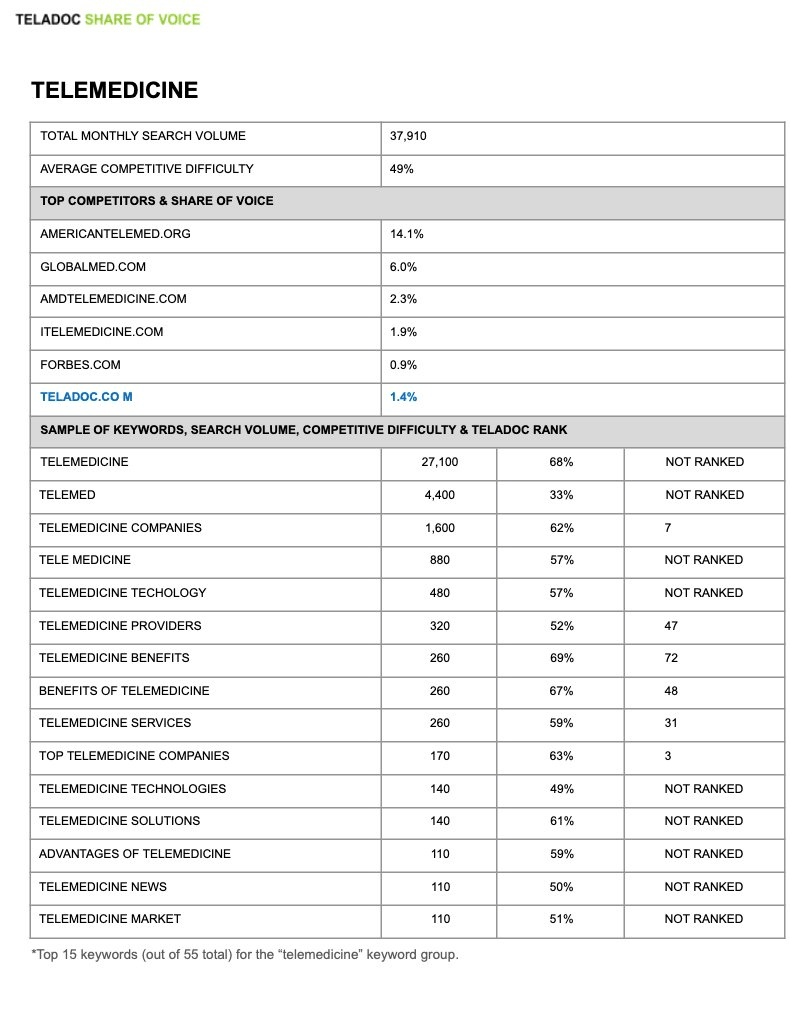
In the searches that defined what Teladoc sold, it held 1.4 percent share of voice. A trade association, several smaller software vendors, and a magazine article ranked above it. For the priority terms, the ones the brand had to own to lead the category, the dashboard read NOT RANKED: telemedicine, telemed, telemedicine solutions, telemedicine technology, and thirty-plus more.
A public company with a growth story to deliver was invisible to the buyers it needed to reach.
It looked like a search problem. It was an ownership problem.
The engagement was contracted as Phase 1 search architecture. That was the symptom. The constraint underneath it was that no one owned how the company’s own category demand turned into members.
Demand for telehealth was growing fast, and Teladoc did not own the asset that captured it. There was no single taxonomy the brand, B2B, and consumer teams agreed on. Thousands of pieces of clinical content sat behind a member login where no buyer could find them. And the measurement layer needed to manage the channel had to be built before anyone could tell whether it was moving.
That pattern is not unique to healthcare. It is the most common constraint I see in founder-led and PE-backed companies: a growth engine that depends on activity nobody owns end to end.
Find. Own. Execute.
Teladoc selected my firm through a formal RFP against more than four bidders. I led the engagement as CEO of the firm and Principal Strategist on the contract: I owned the recommendations, decided what got built, and validated what shipped. The engagement ran about six months.
-
01Find — the real constraint.A share-of-voice audit set the baseline in the first week. A content audit against the new taxonomy surfaced the move that was not in the contract: a hidden library of clinical and member-education content, thousands of pieces, gated where search could not see it.
-
02Own — one taxonomy, one owner, clear decisions.One keyword and audience taxonomy, segmented across seven B2B verticals and signed off by Teladoc’s brand team. Messaging governance and content standards the B2B sales team could use. The work coordinated across B2B Marketing, B2C Marketing, Digital and Content, Creative, PR, Member Experience, and the incoming in-house search function.
-
03Execute — build the asset, prove it, transfer it.Analytics infrastructure, a 310-URL migration map across every legacy domain, a toxic-link cleanup, meta architecture for every rankable page, and a public Knowledge Center to bring the hidden library into search. The Knowledge Center was partially launched and in motion when the engagement closed.
Prove.
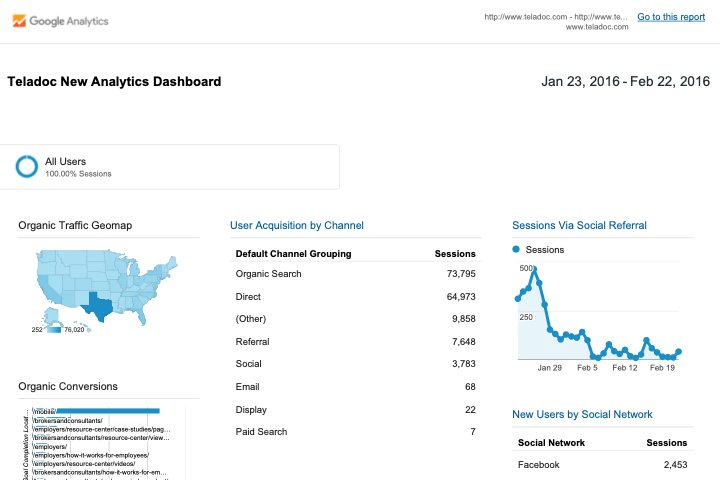
By month five, organic search was Teladoc’s single largest acquisition channel: about 73,800 of roughly 160,000 monthly sessions, 46 percent of all site traffic, more than direct, referral, social, paid, email, and display combined. Six months earlier the priority terms did not rank at all.
Transfer.
In March 2016, Teladoc decided the channel was too important to keep outside the building and hired a full-time Director of SEO. That is the decision a company makes when the work has become core infrastructure. The contract carried a 30-day wind-down. I used it to personally onboard the incoming director: the architecture, the taxonomy, the share-of-voice model, the prioritization logic, and every recommendation still in flight. By the time the contract closed on April 4, 2016, the in-house team could run the channel without us.
Three years later, that same director, by then Director of Digital Marketing at Teladoc Health, reached back out to reopen the conversation. We worked it through several rounds and did not reach terms that matched the scope the work required, so I walked away. The standard I hold on fit is the same one I apply today.
The asset outlived the engagement.
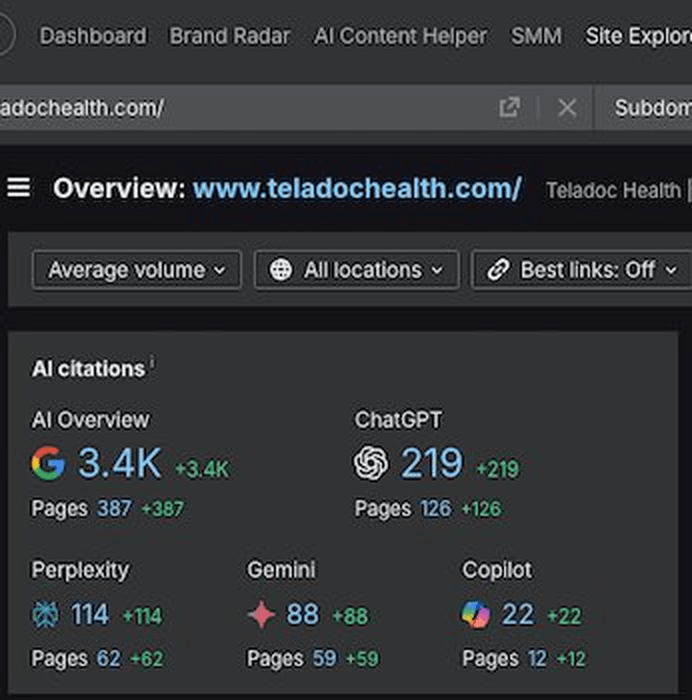
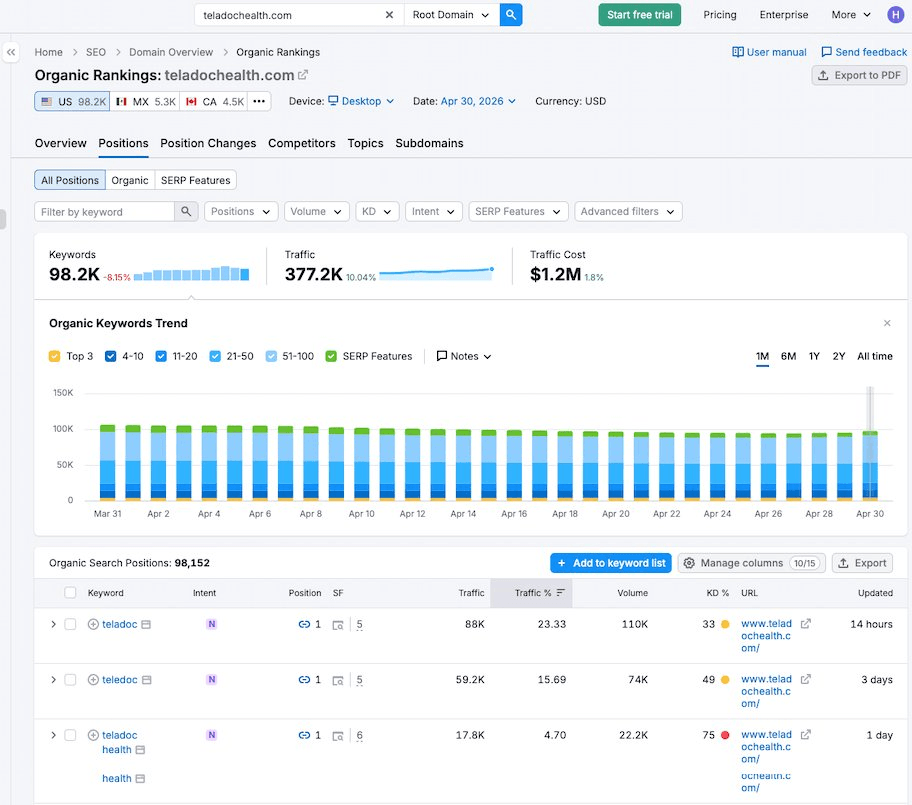
As of April 2026, teladochealth.com ranks for about 98,000 keywords, with an estimated $1.21 million per month in organic traffic value (a SEMrush estimate of what that traffic would cost in paid search, not revenue). It carries 3,400-plus citations in Google’s AI Overviews, with further presence in ChatGPT, Perplexity, Gemini, and Microsoft Copilot.
| Priority term | Sept 2015 | April 2026 |
|---|---|---|
| telemedicine | NOT RANKED | #1 |
| telemedicine services | NOT RANKED | #1 |
| telemedicine companies | NOT RANKED | #1 |
| telehealth services | NOT RANKED | #1 |
| telehealth companies | NOT RANKED | #1 |
| online counseling | NOT RANKED | #1 |
| online doctors | NOT RANKED | #1 |
| virtual doctor | NOT RANKED | #1 |
| virtual doctor visit | NOT RANKED | #1 |
| virtual healthcare | NOT RANKED | #1 |
| online medical consultation | NOT RANKED | #1 |
| online doctor | NOT RANKED | #3 |
| telehealth | NOT RANKED | #4 |
Eleven of the original priority terms now sit at #1. Two more sit inside the top four. Telehealth itself, the broadest term in the category at 149,000 monthly searches, holds #4 against major-publisher competition that arrived years after the foundation was set.
The structure recommended in 2015, a public health library, segmented B2B resource centers, vertical insight hubs, and clinically reviewed expert content, is the structure live on the site today.
The honest ledger.
The in-house team ran, scaled, and maintained the channel for the ten years that followed. I do not get credit for their work, and I do not want it. Here is the split.
- Strategic ownership of the architecture phase, September 2015 through April 2016, as CEO of the firm and Principal Strategist.
- The blueprint: share-of-voice methodology, audience and keyword taxonomy, library-first content architecture, segmented resource centers, and vertical insight hubs.
- The documented move from not ranked on priority terms to 46 percent organic share of site traffic inside the engagement window.
- Recommending, architecting, and partially launching structural assets that are still live today.
- Personally onboarding the incoming in-house director during the handoff.
- The decade of organic growth that followed. The operators in the seat after me did that work.
- Teladoc’s current traffic value, keyword count, AI citation presence, or revenue.
- Day-to-day execution of the channel from May 2016 forward.
- Any role in Teladoc’s IPO, stock performance, acquisitions, or corporate strategy.
I built the foundation and transferred it. The in-house team compounded it. That is how the work is supposed to end.
Growth that holds without the people who built it.
If you run a founder-led company.
If growth depends on a channel you rent, a vendor you cannot replace, or you personally being in the room, that dependency is the constraint. The fix is not more activity. It is an owned system, with a named owner, that your team can run without you.
If you sit on a PE-backed leadership team.
A buyer pays for what keeps working after the founder, the agency, and the operating partner are gone. Documented, owned, transferable growth infrastructure is part of what makes a business worth more at exit, and it has to be built well before the process starts.
The work is not marketing-only.
Teladoc’s constraint happened to sit in how the company captured demand. In your business it may sit in sales, operations, finance, or people. A Growth Operating Partner engagement spans all five lanes, because growth rarely stalls inside one department. It stalls at the constraint no one owns.
I set the direction and stay accountable for the result. Execution runs through your existing team, a team I stand up, or the partners I direct. The position holds. The depth flexes.
Two ways to start.
Stuck? Ask Hank™.
One business, growth, or execution problem you want my thinking on. A paid 30-minute working session, not a discovery call. Bring the problem. We’ll work the problem.
Ask Hank™ →30 minutes · $100
Discuss a Growth Operating Partner engagement.
For founders, CEOs, and PE-backed leadership teams with a larger growth mandate that needs cross-functional direction, execution, and operating accountability. I review every submission personally.
Discuss an Engagement →Download the one-page PDF (116 KB)
Find what matters. Own the outcome. Execute until the mission is accomplished.